
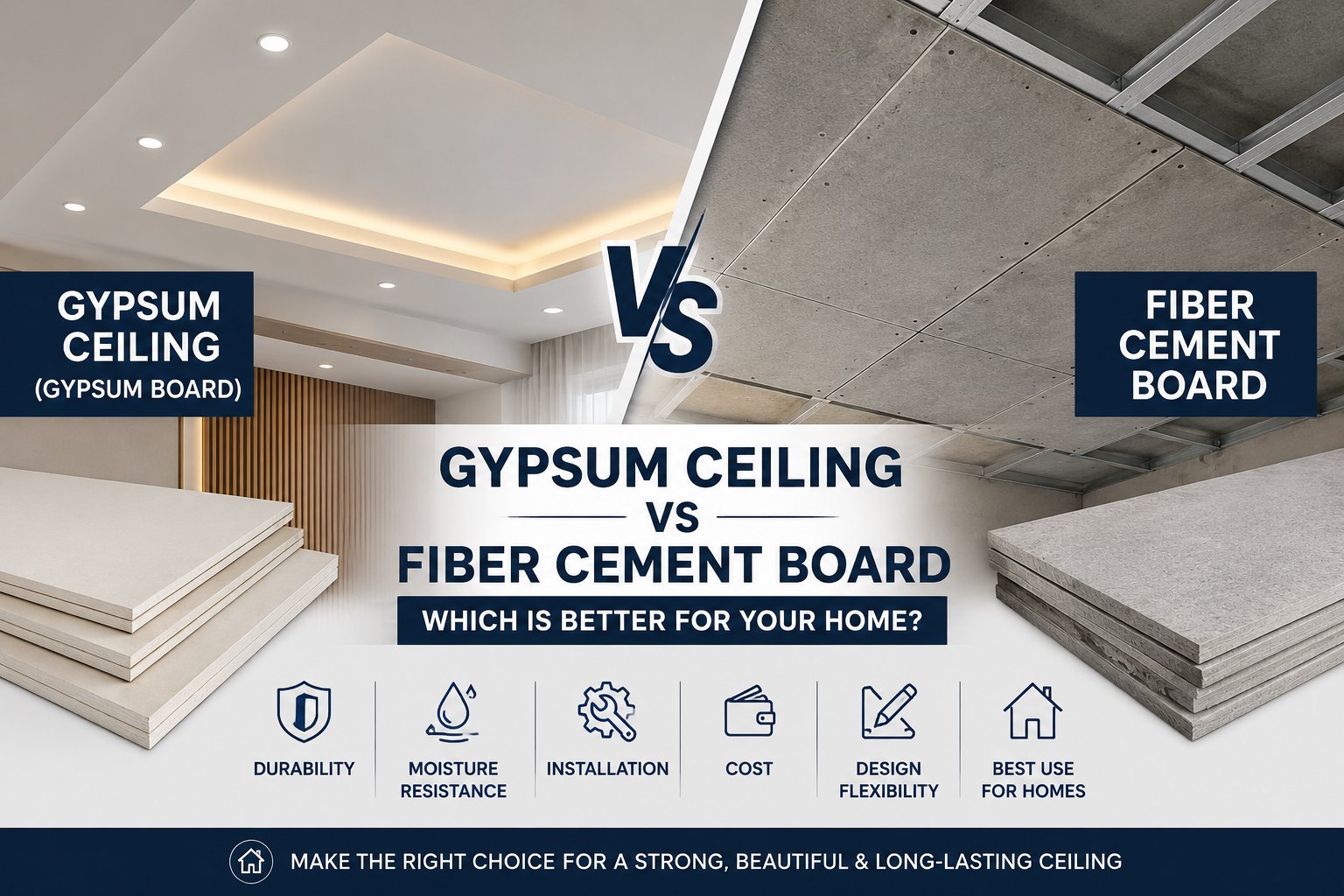
Gypsum Ceiling vs Fiber Cement Board: Which Is Better for Residential False Ceilings?
Gypsum Ceiling vs Fiber Cement Board: Which Material Is Better for Residential False Ceilings?
If you're planning a home renovation in Dubai, you've probably run into one big decision: what should your false ceiling actually be made of?
Most homeowners narrow it down to two options — a gypsum board ceiling or a fiber cement board ceiling. Both look great in photos. Both are sold by dozens of contractors across the city. But they behave very differently once installed in a real Dubai home, with real heat, real humidity, and real daily wear.
This guide breaks down both materials honestly, using practical comparisons rather than sales talk, so you can choose the right one for your villa, apartment, or townhouse.
Understanding Gypsum Board Ceilings
A gypsum board ceiling is made from gypsum plaster pressed between two layers of thick paper, then cut into boards and fixed onto a metal or timber frame suspended below the original concrete slab.
This is sometimes called a suspended gypsum ceiling, because the board hangs a few inches below the actual roof, creating a gap that's used to hide wiring, AC ducting, and plumbing lines.
Gypsum boards are the most commonly used gypsum ceiling panels in residential interiors across the UAE, largely because they're lightweight, easy to shape, and finish beautifully with paint.
What Gypsum Ceilings Are Typically Used For
- Living rooms and bedrooms
- Hallways and corridors
- Dining areas
- Decorative cove lighting and multi-level ceiling designs
- Villas, apartments, and townhouses across Dubai
Because the boards can be cut, curved, and layered, they're the go-to material whenever a homeowner wants a gypsum ceiling design with depth — stepped edges, circular patterns, or hidden LED lighting channels.
What Is Fiber Cement Board?
Fiber cement board is a denser building material made from cement, sand, and cellulose fibers, compressed under high pressure. It was originally developed for exterior cladding and wet-area applications, and later adapted for interior ceilings in specific settings.
Unlike gypsum, fiber cement board doesn't contain paper facing, which makes it naturally more resistant to moisture and less prone to sagging in humid conditions.
Where Fiber Cement Board Is Commonly Used
- Bathrooms and wet kitchens
- Balconies, majlis extensions, and semi-outdoor sitting areas
- Laundry rooms and utility areas
- Basements with higher humidity levels
- Commercial kitchens or service corridors
It's a practical, functional material — but it isn't usually chosen for decorative ceiling work, since it doesn't cut or curve as easily as gypsum.
Key Differences Between Gypsum Board Ceiling and Fiber Cement Board
Here's a side-by-side comparison covering the factors that actually matter to Dubai homeowners.
| Factor | Gypsum Board Ceiling | Fiber Cement Board |
|---|---|---|
| Weight | Lightweight, easy to suspend on standard metal frames | Noticeably heavier, needs a stronger supporting frame |
| Appearance | Smooth, paintable, ideal for modern and decorative designs | Slightly textured, less refined finish out of the box |
| Installation | Fast, simple, widely understood by local contractors | Slower, requires more careful handling and cutting tools |
| Durability | Good for dry indoor rooms; can dent or chip on impact | Very tough, resists impact and rough handling |
| Moisture Resistance | Moderate; regular boards absorb moisture over time (moisture-resistant variants available) | High; naturally resists humidity and dampness |
| Maintenance | Easy to repaint and touch up | Harder to patch; usually needs panel replacement |
| Cost | More affordable overall | Generally 20–35% more expensive per square foot |
| Fire Resistance | Good, especially fire-rated gypsum boards | Excellent, naturally non-combustible |
| Acoustic Performance | Good sound dampening with proper insulation backing | Slightly denser, offers marginally better sound blocking |
| Best Applications | Living rooms, bedrooms, false ceiling designs, cove lighting | Bathrooms, balconies, wet areas, utility spaces |
Quick takeaway: if you're ceiling a normal living space, gypsum wins on cost, design flexibility, and ease of installation. If you're ceiling a wet or high-humidity area, fiber cement board is the safer long-term choice.
Advantages of Gypsum Board Ceilings
Gypsum remains the default choice for residential interiors in Dubai, and for good reason.
- Design flexibility — curves, steps, coves, and multi-layer patterns are all achievable
- Lightweight structure — puts less load on the ceiling frame and concrete slab
- Smooth paintable surface — matches any interior color scheme
- Faster installation — most rooms are completed within a few days
- Better integration with lighting — ideal for recessed spotlights, LED strips, and cove lighting
- Cost-effective — lower material and labor cost compared to fiber cement
- Easy repairs — small cracks or holes can be patched and repainted without replacing the whole panel
For homeowners focused on aesthetics — especially those working with an interior designer on a gypsum ceiling design — this material simply offers more creative room to work with.
Advantages of Fiber Cement Boards
Fiber cement isn't as popular for full-home ceilings, but it earns its place in specific rooms.
- Excellent moisture resistance — handles humidity without swelling or sagging
- High impact resistance — less likely to dent or crack under pressure
- Non-combustible — a strong safety advantage in fire-sensitive areas
- Long lifespan in wet zones — performs well in bathrooms, laundry rooms, and semi-outdoor spaces
- Pest resistant — unlike paper-faced gypsum, it doesn't attract termites or mold growth as easily
If your priority is durability over decoration, fiber cement earns a legitimate spot in your renovation plan — just not usually for the whole house.
When Should You Choose a Gypsum False Ceiling?
A gypsum false ceiling makes the most sense when:
- You want a decorative, modern ceiling with cove or spotlighting
- The room is dry and climate-controlled (living rooms, bedrooms, majlis, hallways)
- You're working within a moderate renovation budget
- You want the ceiling installed quickly with minimal disruption
- You plan to repaint or update the interior color scheme over time
For roughly 80–90% of residential spaces in a typical Dubai villa or apartment, gypsum remains the practical, design-friendly answer.
When Is Fiber Cement Board a Better Choice?
Fiber cement board is worth the extra cost when:
- The ceiling is in a bathroom, wet kitchen, or laundry area
- The space experiences frequent condensation (basements, semi-outdoor majlis)
- Fire-rating requirements are strict, such as near kitchens with heavy cooking use
- You need a ceiling that resists impact in high-traffic utility zones
A smart approach many Dubai homeowners take: use gypsum for the main living areas, and fiber cement selectively in bathrooms and wet zones. This hybrid approach balances design with practicality.
Gypsum Board Ceiling Installation: What Homeowners Should Know
Understanding the basic process of gypsum board ceiling installation helps you evaluate contractor quotes and avoid poor workmanship.
1. Measurement and design planning. The installer measures the room and marks the ceiling level, factoring in AC ducts, wiring, and any drop-ceiling design.
2. Frame installation. A metal grid (channels and sections) is fixed to the concrete slab using suspension rods, creating the frame that will hold the gypsum boards.
3. Board fixing. Gypsum boards are screwed onto the metal frame, joint by joint, leaving room for electrical fittings and AC diffusers.
4. Jointing and finishing. Joints between boards are taped and filled with jointing compound, then sanded smooth so no seams are visible.
5. Priming and painting. A coat of primer followed by paint completes the ceiling, ready for lighting fixtures to be installed.
Questions to Ask Your Contractor Before Installation
- Are the boards moisture-resistant grade or standard grade?
- What gauge is the metal framing system?
- How is the ceiling gap used for AC ducting and wiring?
- What warranty is offered on workmanship?
A well-installed suspended gypsum ceiling should have no visible seams, no sagging, and a completely level finish — this comes down to the skill of the installation team, not just the material.
Gypsum Board Ceiling Cost Factors in Dubai
Gypsum board ceiling cost in Dubai varies based on several factors rather than a single flat rate. Here's what actually drives the price:
| Cost Factor | Impact on Price |
|---|---|
| Ceiling design complexity | Simple flat ceilings cost less than multi-level or curved designs |
| Board type | Standard boards are cheaper; moisture-resistant or fire-rated boards cost more |
| Room size | Larger rooms mean more material and labor, though per-square-foot rates may drop slightly |
| Lighting integration | Cove lighting, spotlights, and LED channels add to labor cost |
| Framing material quality | Higher-gauge metal framing costs more but lasts longer |
| Number of levels/steps | Multi-tier designs require more cutting, framing, and finishing time |
| Access and building type | High-rise apartments may involve different logistics than villas |
Practical tip: Always ask for a detailed quote broken down by material, labor, and design add-ons. This makes it much easier to compare contractors fairly, rather than comparing vague lump-sum numbers.
Modern Gypsum Ceiling Design Ideas
A well-planned gypsum ceiling design can completely transform how a room feels. Popular styles among Dubai homeowners include:
- Cove ceilings — a recessed edge around the room perimeter that hides LED lighting for a soft glow
- Tray ceilings — a stepped, layered center panel that adds depth to living rooms and master bedrooms
- Geometric patterns — angular or curved cutouts used as a decorative centerpiece
- Floating ceiling panels — a suspended central panel with a visible gap and hidden lighting, popular in majlis and dining areas
- Minimalist flat ceilings with recessed spotlights — a clean, low-maintenance option for modern apartments
If you're unsure which style fits your home, it helps to look at your existing interior first — a heavily decorated majlis suits a tray or geometric design, while a minimalist apartment usually looks better with a clean, understated finish.
Common Mistakes Homeowners Make When Choosing Ceiling Materials
Avoid these frequent renovation mistakes:
- Using standard gypsum boards in bathrooms or wet kitchens — leads to swelling, staining, and mold over time
- Ignoring AC duct placement before installation — causes rushed, poorly planned ceiling cutouts later
- Choosing the cheapest quote without checking board thickness or grade — thinner boards sag and crack faster
- Skipping moisture-resistant boards in humid areas — a false economy that costs more in repairs later
- Overcomplicating the design for a small room — multi-level ceilings can make low-ceiling rooms feel cramped
- Not asking about warranty on installation workmanship — a good material poorly installed will still fail
A little planning before installation day prevents most of these issues entirely.
Final Verdict
For most homes in Dubai, a gypsum board ceiling is the more practical and design-friendly choice — it's lighter, more affordable, faster to install, and far more flexible when it comes to decorative lighting and layered designs. Fiber cement board still has its place, particularly in bathrooms, wet kitchens, and utility areas where moisture resistance matters more than aesthetics.
The smartest approach for many homeowners is a hybrid one: gypsum throughout the main living spaces, and fiber cement board where humidity is a genuine concern. What matters most, regardless of material, is working with an installer who understands Dubai's climate, uses the right board grade for each room, and finishes the job with clean, seamless workmanship.
Get It Done Right the First Time
Choosing between gypsum and fiber cement is only half the decision — the other half is finding a team that installs it properly. At Zush, our team specializes in Residential False Ceiling Company services across Dubai villas and apartments, from simple flat finishes to detailed Gypsum Residential Ceiling work with cove lighting and multi-level layouts.
Whether you need a straightforward Gypsum Ceiling Installation, a full Suspended Gypsum Ceiling system, or expert advice on which material suits your specific rooms, our team can guide you through the right choice for your home and budget.
Get a Free Quote